Asian vs. Latin American Sourcing Agencies: A Practical Comparison for U.S. Importers
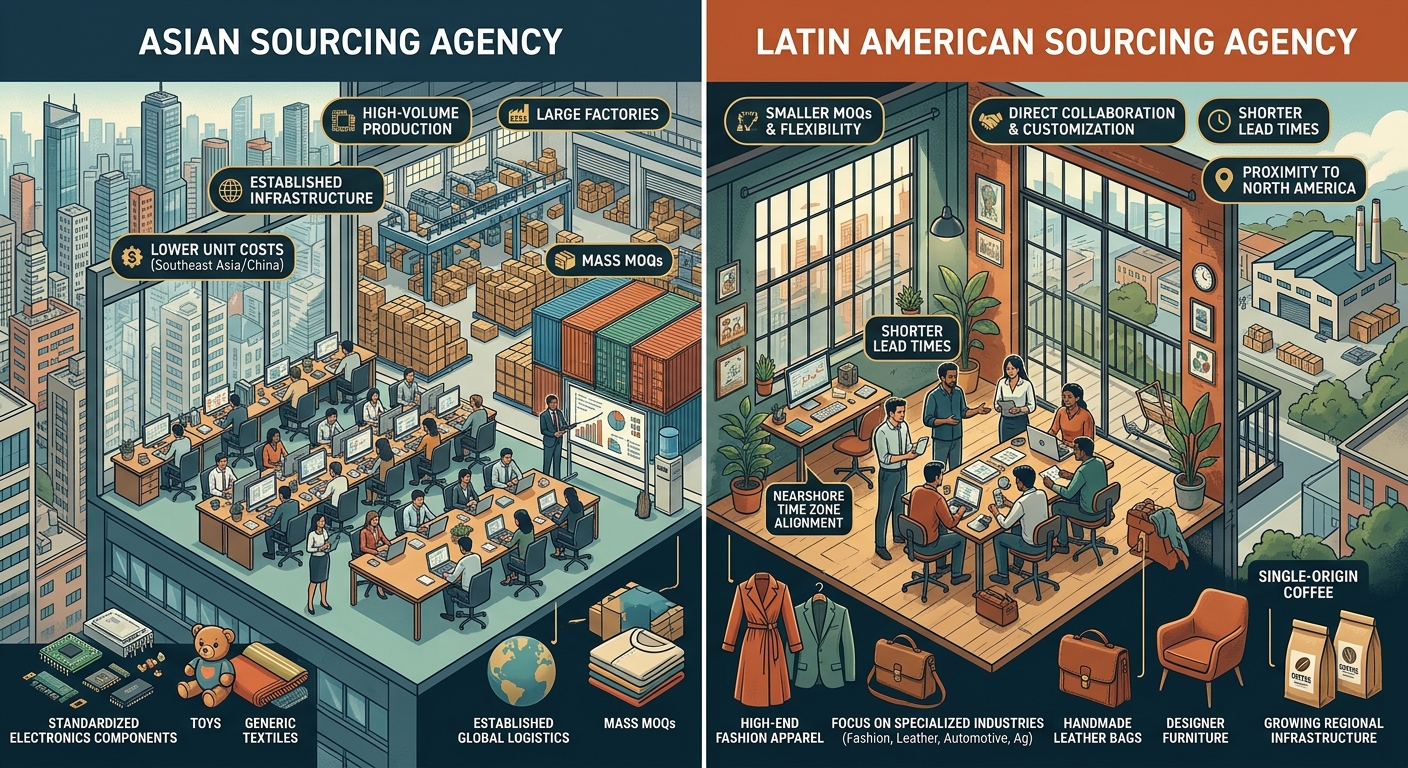
If you're evaluating sourcing agencies, the region they operate in shapes almost everything: factory access, MOQ norms, lead times, and how much hand-holding you'll get on quality control. Asia and Latin America each have genuine advantages — the right choice depends on your product, your volume, and how fast you need to move.
What Asian Sourcing Agencies Bring to the Table
Asia — primarily China, Vietnam, India, Bangladesh, and Indonesia — remains the dominant manufacturing region for most hard goods, apparel, electronics, and consumer products. Sourcing agencies based here have spent decades building factory networks, which translates into real leverage on price and capacity.
Where Asian agencies tend to excel:
- Volume and specialization. Factories in China and Southeast Asia have high throughput and deep specialization by product category. If you're sourcing injection-molded plastics, PCBs, garments, or furniture at scale, there are clusters of factories that do nothing else.
- Established QC infrastructure. Third-party inspection services (AQL audits, pre-shipment inspections) are mature and widely available across major manufacturing hubs.
- Supplier variety. A sourcing agent in Guangzhou or Ho Chi Minh City typically has access to dozens of competing factories for any given product, which creates negotiating room.
- Lower unit costs at scale. For orders above $20,000–$30,000, landed costs from Asia are often still difficult to beat even after freight.
The trade-offs:
- Ocean freight from Asia to the U.S. East or West Coast runs 18–35 days depending on origin port, plus inland transit.
- Time zone gaps (12–15 hours) slow communication cycles.
- Post-2020 tariff structures on Chinese goods in particular have eroded cost advantages for many categories.
What Latin American Sourcing Agencies Offer
Latin America — Mexico, Colombia, Peru, Brazil, and increasingly Guatemala and Honduras — has grown significantly as a sourcing destination for U.S. buyers, particularly post-pandemic. Agencies in this region are generally smaller and more relationship-driven than their Asian counterparts.
Where Latin American agencies tend to excel:
- Nearshore speed. Ocean freight from Mexico or Colombia to U.S. ports runs 5–12 days. Some buyers use cross-border trucking from Mexico, cutting lead times further.
- Tariff advantages. USMCA (Mexico and Canada) eliminates or reduces duties on qualifying goods. Several other Latin American countries have preferential trade agreements with the U.S. that Asian suppliers cannot match.
- Communication and cultural alignment. Closer time zones (0–4 hours difference) mean faster turnaround on samples, spec revisions, and production questions.
- Textile and apparel specifics. Peru and Colombia have well-developed textile industries with competitive pricing on premium fabrics, knitwear, and activewear.
- Smaller, more flexible runs. Latin American factories often accept lower MOQs than comparable Asian factories, which suits buyers doing smaller replenishment orders or testing new SKUs.
The trade-offs:
- Unit costs for many categories are higher than Asia, sometimes significantly so.
- Manufacturing depth is narrower — you won't find the same breadth of suppliers for electronics, machinery, or complex hard goods.
- QC and compliance infrastructure is less standardized in some countries; vetting factory certifications requires more due diligence.
Side-by-Side: Key Decision Factors
| Factor | Asian Agencies | Latin American Agencies | |---|---|---| | Transit time to U.S. | 18–35 days (ocean) | 5–12 days (ocean/truck) | | Unit cost (most categories) | Lower at volume | Higher, offset by tariff savings | | Tariff exposure | High for China; moderate for Vietnam/India | Low under USMCA and bilateral FTAs | | MOQ flexibility | Higher MOQs typical | More flexible for smaller runs | | Category breadth | Very broad | Narrower; strongest in textiles/food/agriculture | | QC infrastructure | Mature and widely available | Developing; varies by country | | Communication | Slower due to time zones | Faster; more accessible |
How to Choose
A few straightforward rules of thumb:
1. If your order value is above $50,000 and you're buying hard goods, electronics, or complex manufactured products — Asian agencies almost certainly have better factory access and lower costs despite freight.
2. If you need fast replenishment, have lower MOQs, or your product qualifies for USMCA — a Latin American agency deserves a serious look. The math often works out favorably once you factor in reduced freight costs, shorter cash cycles, and lower duty rates.
3. If you're sourcing apparel or textiles — run quotes from both regions. Peruvian and Colombian manufacturers are genuinely competitive on premium knitwear and activewear, while Bangladesh and Vietnam still dominate on basic cut-and-sew at volume.
4. Consider splitting your supply base. Some buyers source core high-volume SKUs from Asia and use Latin American suppliers for fast-turn or test orders. This adds complexity but reduces risk concentration.
Vetting Either Type of Agency
Regardless of region, ask any sourcing agency the same baseline questions before engaging them: How many factories do they have audited relationships with in your category? Do they charge a flat fee, a percentage of FOB value, or both? Can they provide references from buyers with similar product types and order sizes? Do they have in-house QC staff or do they subcontract inspections?
The region matters, but the agency's actual factory network and accountability structure matter more.